Blog

South Pacific: It’s About the Waiting

Tales of the South Pacific

By James A. Michener

Published 1947

Read Oct 2020

Although this reader had never actually seen a stage or film version of Rogers and Hammerstein’s “South Pacific”, three songs jumped into her brain immediately when this book was selected as a book for this reader’s book discussion group:  “Some Enchanted Evening”, “I’m Going to Wash That Man Right Out of My Hair”, and “Bali-ha”.  This reader is happy to report this book is quite engaging and serious and not at all what this reader was expecting from the familiar songs—a light romantic comedy. 

When first released (the book in 1947 and musical in 1950), memories of World War II remained fresh in readers and viewers minds.  The book won the Pulitzer Prize for fiction and the musical won the Pulitzer Prize for drama.   The musical was adapted for the screen twice:  for the big screen in 1958 (the film was a blockbuster) and for TV in 2001.   What accounts for this appeal in the late 40’s and 50’s and what accounts for the familiarity for even this generation?

James Michener was 40 when he enlisted in the US Navy.  He was sent to the South Pacific. He earned the rank of lieutenant commander and had various assignments.  He began compiling his observations about his experiences during that time.  Michener begins his book “I wish I could tell you about the South Pacific.  The way it actually was.  The endless ocean.  The infinite specks of coral we called islands.  …. I wish I could tell you about the sweating jungle, the full moon rising behind the volcanoes, and the waiting.  The waiting.  The timeless, repetitive waiting. But whenever I start to talk about the South Pacific, people intervene.” 

 Michener’s book (his first of over 40) is a collection of related short stories told, after the introductory piece, in approximate chronological order.  Each chapter is a complete story in itself and characters from one story carry into other stories.  While the stories can be read individually, knowledge of previous stories provides more depth of understanding of aspects of the story at hand.   The author makes clear who is narrating in each story.  Most of the stories are narrated by an officer who completes a range of assignments supporting various commanding officers.   In each case, the reader feels as though the narrator is speaking directly to him/her.

The stories are about the people who serve on the islands on which equipment and supplies were landed to support various campaigns and where airplanes and PT boats landed and were repaired.  They are about the US Seabees who build the beaches on which the Marines and Sailors land to take control of the island and the airstrips that are used by US Navy airplanes of all sizes that fulfill various purposes:  bombers, dogfighters, scouting, etc. They are about the officers who have a variety of roles including supply officers, doctors, nurses pilots, communications officers, and recreation officers (this one focused on enabling “the waiting” to be bearable).  They are about the men who sweat in the hot humid climate and try to stay sane while waiting for the call to action.  They are about the coast watchers who provide the Navy vital information regarding the movement of their Japanese enemies.  They are about the nurses who are officers but who generally have backgrounds more like the enlisted men, with whom they are forbidden to socialize, than with the male officers.  They are about the officers that engage their men to build an airstrip in the middle of a jungle in 15 days and they are about the officers that disengage their men through arbitrariness and disinterest in their needs.  They are about the French plantation owners and their native and Tonkinese (North Vietnamese) workers that live on the islands.  They are about the entrepreneurial Tonkinese who gladly sell the sailors and marines what they need across a wide range of goods and services.  There several love stories, two which are a large focus of the musical. (The three unforgettable songs that are in this reader’s brain are related to these love stories.) The stories confront prejudices borne by the Americans regarding the various people living on the islands.   (The musical confronted this issue directly as well.)  The stories are stitched together by the recurring characters and how their experiences impact them.  The stories lead from the pronouncement of a group of admirals to take a particular island through the development of Plan Alligator to the strike on the targeted island and the aftermath of that battle.

Although not written as historical fiction, it serves as such to those reading it in 2020.  An indicator of good historical fiction, according to this reader, is that the reader is motivated to learn more about the subject.  Michener’s book had that effect on this reader.  Michener’s book provides the human face to that part of the war and gives it life that “regular” history books and TV programs using film from the time don’t provide.  This reader has a new appreciation both for the magnitude of the undertaking of the war in the South Pacific and the lives of the peoples involved.  And those songs will remain firmly embedded in her brain.
Go Went Gone: How Do We Deal with Other

Go Went Gone

By Jenny Erpenbech

Translated from German by Susan Bernofsky

Published 2015

Read Sept 2020

The protagonist, Richard, is a recently retired classics professor.  He is somewhat disoriented in these early days of retirement when the highlights of his day may include a trip to the urologist.  On a walk in a nearby square he sees a “tent city” occupied by what he discerns to be African refugees.  He becomes interested in how his German government is dealing with them and he decides to do a “study”.  By the time he has formulated a long list of questions for the refugees he hopes to interview, the refugees have been placed in several living situations including a wing of a nearby nursing home.  He visits there and begins a relationship with several of the refugees.  Their names are complicated for him so he identifies them (only to himself) with names suggested by his classics background—Apollo, Tristan, Olympian, Thunderbolt-hurler.  Over the course of the story he learns about German law regarding refugees, including the agreement with the European Union countries that only the country of original entry into the EU can grant asylum. Most of these refugees from various African countries entered after their (usually overloaded) boat landed in Italy.  Italy has no work for them so they have come to Germany in search of work.  Since they have no official status in Germany, they aren’t allowed to work.  As these refugees are black, they encounter racial prejudice as well as the barriers of their refugee status.

The title Go Went Gone is an interesting one as it applies to several aspects:  Richard’s academic career is gone (he is retired);  his wife is gone (he is now a widower); his lover is gone (she’s left him), the country where he was born and raised (East Germany) is gone (being now part of unified Germany); the refugees’ ability to work for a living is gone (no legal status = no right to work); the refugees’ ability to stay in Germany is going (once their cases are heard they will be deported to Italy); the refugees are endeavoring to learn German and are learning how to conjugate verbs in this new language (although most speak several other languages). 

The author’s depiction of Richard’s disorientation as a new retiree is very realistic based on this reader’s own experience—feeling a loss of identity and associated worth, feeling of isolation from former colleagues, feeling that days are endless in the absence of work. The disorientation is amplified by the loss of his wife and his lover.   A positive aspect of retirement is noted—absent external expectations from the department, university, or other career responsibilities, reading and writing can feel freer and new veins of thinking are available even in texts previously well explored.    Similarly his consideration of the impact of the reunification on the geography and societal aspects of his neighborhood and life as a result of Germany’s reunification are considered more closely now. 

The story provides the reader much opportunity to consider regarding refugees and immigration—who should be allowed to work/what barriers are appropriate for non-citizens to their ability to make a living/contribute to society;  what is the appropriate definition of “citizen” and who has the right to make that definition; are immigration laws truly seeking to protect job access for citizens or are they seeking to prevent “others” from crossing borders; how did political borders get drawn—why and by whom; who has the right to define “other”. 

There are no simple answers and the author doesn’t suggest there are.   The book’s ending is appropriately not the ending of the story for Richard or the refugees he’s met.  The courses of all their lives remain uncertain– as is the actual case for all of us.  What is clear is that the flow of refugees/immigrants has always existed and will continue to exist as people flee war/political issues and/or seek a better life than they have where they are.   Borders are man-made.  Arguments over borders are man-made.  The constant flow of people away from strife will continue to challenge people to decide how they will accept “others” into “their” space. 

Leadership in Turbulent Times—Relevant Lessons for Today

Leadership in Turbulent Times

By Doris Kearns Goodwin

Published 2018

Read Aug 2020

Doris Kearns Goodwin served in Lyndon Johnson’s White House and helped him write his memoirs after he left office, the latter while she was a professor at Harvard University.  Her experiences with him and extensive research led to publication of “Lyndon Johnson and the American Dream”.  She later wrote “No Ordinary Time:  Franklin and Eleanor Roosevelt:  The Home Front in World War II”“Team of Rivals”, a book about Abraham Lincoln’s cabinet and presidency, and “The Bully Pulpit” about Theodore Roosevelt friendship with William Howard Taft.  Thus she had spent countless hours with the men highlighted in this book long before she began writing it.  She remarks in the foreword to this volume that she found much to learn about them through the “elusive theme of leadership”.   She also points out in the foreword that Lincoln’s model leader was George Washington, Theodore Roosevelt’s great hero was Lincoln, Franklin Roosevelt molded his career on Theodore Roosevelt’s, and Lyndon Johnson considered Franklin Roosevelt his “political daddy”.  So these men become a “leadership family tree” of sorts.

Goodwin discusses each man in chronological order, Abraham Lincoln, Franklin Roosevelt, Theodore Roosevelt, and Lyndon Johnson, in three sections:  Ambition and the Recognition of Leadership; Adversity and Growth; The Leader and the Time:  How they Led.  She uses a story-telling approach to her work and engages the reader deeply into the topic at hand for each person.  She shows how each man’s beginning and adversity shaped his leadership approach and his view of himself.  Each man’s leadership was shaped by the needs of the country at the time and the needs of the country impacted his particular leadership approach. This reader was particularly interested in how Johnson engaged Congress which enabled him to get the Civil Rights Act of 1964 passed as well as the Voting Rights Act of 1965 and a number of other sweeping bills.  He knew that without involving stakeholders early and often and without close interaction with Congress he wouldn’t get things done.   These approaches haven’t been very visible in recent years.

Goodwin switches the order in the Epilogue:  Of Death and Remembrance starting with Lyndon Johnson, with whom she had a deep relationship forged during his administration and especially while writing his memoirs.  She appropriately calls out the failings of his leadership with respect to the Vietnam War and recounts Johnson’s ruminations of these during his post-presidency period.  She recounts his last public appearance.   “The plight of being “Black in a White society,” he argued, remained the chief unaddressed problem of our nation.   “Until we address unequal history, we cannot overcome unequal opportunity. “ Until blacks “stand on level and equal group,” we cannot rest.  It must be our goal “to assure that all Americans play by the same rules and all Americans play against the same odds.”  Unfortunately the gains in civil rights he personally drove through Congress from the White House, while enabling enormous progress, have stalled and the goal he delineates remains incomplete.

Goodwin does not provide a formula for leadership.  However, her final statements in the book sheds light on the essence of what the nation needs in these current extremely turbulent times:  “ Kindness, empathy, humor, humility, passion, and ambition all marked him [Lincoln] from the start.  But he [Lincoln] grew, and continued to grow, into a leader who became so powerfully fused with the problems tearing his country apart that his desire to lead and his need to serve coalesced into a single indomitable force.  [Italics added by this writer] That force has not only enriched subsequent leaders but has provided our people with a moral compass to guide us.  Such leadership offers us humanity, purpose, and wisdom, not in turbulent times alone, but also in our everyday lives.”

This is a useful book for learning how four presidential leaders developed into leaders and provides models for leaders moving forward.  This reader hopes those seeking political office read these words and incorporate these lessons into their own work to serve.

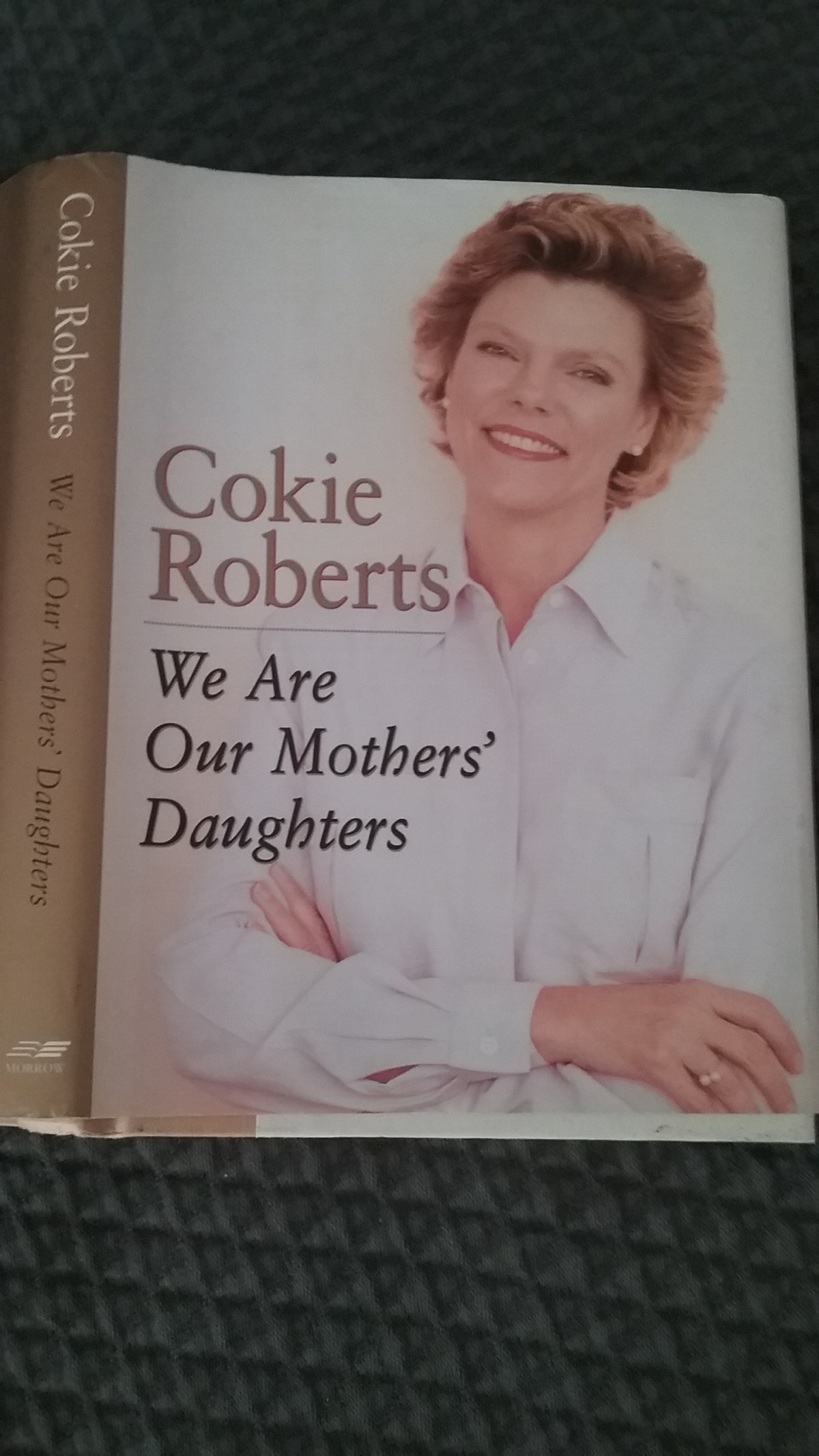
We Are Our Mothers’ Daughters–a Slim Powerful volume from Cokie Roberts

We Are Our Mother’s Daughters

By Cokie Roberts

Published 1998

Read Sept 2020

This reader found a copy of the 1998 edition of this small book in a Little Library—a great place to find reading treasures.  Apparently there is a second edition published in 2009 that my comments can’t cover.

This reader has listened to NPR for about 30 years so Cokie’s contributions to radio news and those of the other “Founding Mothers” of NPR are well known to this reader.  This reader is also familiar with Cokie’s participation on This Week with David Brinkley and her turn at the helm of that vehicle with Sam Donaldson.  It is somewhat sobering to this reader that this generation of news reporters in these vehicles, whom this reader has followed for 30+ years, is leaving us to retirement or beyond.   We lost Cokie to complications of cancer in 2019.

Cokie’s book is a highly personal one—chapters on her personal experiences as Sister, Aunt, Friend, Reporter, Wife, and Mother/Daughter give us an insight on her personal life.  She was a daughter of politician parents—Congressman Hale Boggs and Congresswoman Lindy Boggs;  a sister of a Princeton, NJ mayor (Barbara)  and of a successful lawyer/lobbyist (Tommy).  She was wife and eventual column co-author of journalist Steve Roberts and mother of two children.  She describes her pursuit of Steve Roberts during and following graduation from Wellesley College in 1964 when she had a goal of marriage and motherhood before she was too old (they married when she was 22 and he 23).  She describes her decisions over the years to follow Steve to New York, Greece, LA, and then Washington, D.C.  Through it all she realized she too must work to be complete and did so with gusto so that she become a the well-known and well-respected journalist.

Cokie also chose to include chapters or chapter portions about famous and not-so-famous women and how they made inroads into “men’s world jobs” of mechanic, activist, journalist, enterpriser, and politician.  She indicates she does not provide any original research about women in history.

This book is Cokie’s take on that age-old question “What is woman’s place” and how she sees it.  She offers no answers to how can women have ‘balance” (she in fact suggests that’s really never going to happen).  She offers observations on how she has experienced life during the “great social movement” that propelled women more completely into life outside the home.  She chastens women with choices in their life-role for judging other women’s choices — especially when those judged really have very limited choices.

The best paragraph in the book quotes Margaret Chase Smith as she wrote in the introduction to the book “Outstanding Women Members of Congress” in answer to “Where is the proper place of women?”:  “My answer is short and simple—woman’s proper place is everywhere.  Individually it is where the particular woman is happiest and best fitted—in the home as wives and mothers; in organized civic, business, and professional groups; in industry and business, both management and labor; and in government and politics. Generally, if there is any proper place for women today it is that of alert and responsible citizens in the fullest sense of the word.”

If you were a fan of Cokie Roberts, you will enjoy this small volume, hearing Cokie’s voice again as she covers topics important to the hearts of women of all ages.  If Cokie Roberts is less known to you, read this book to get a sense of a memorable woman who brought much to the world of political journalism and to all those who knew her.


Girls Burn Brighter

Girls Burn Brighter

By Shobha Rao

Published 2018

Read Aug 2020

This premier novel from Rao, born in India but migrated to the US at age 7, depicts the story of two girls’ struggle to retain their “brighter” selves despite relentless abuse they suffer. Poornima’s mother has died of cancer and her father’s alcoholism keeps the family struggling to eat.  He uses a marriage broker to seek a husband for Poornima but his meager estate makes this difficult.  Savitha’s family is even poorer, living on and picking through the local trash heap.  Savitha ends up working for Poornima’s father’s weaving business and the two girls kindle a friendship that helps them continue to “burn brighter” despite the obstacles they encounter.   The novel alternates between the stories of the two girls. The two girls end up in “thrown away” situations for different reasons which won’t be revealed here and are separated. 

This reader listened to the novel.  The reader was generally breathless, except in dialog sections. This reading style became somewhat annoying to this reader.  The non-dialog prose may have prompted this approach as it was sometimes nearly over the edge as it describes the relentless abuse the girls suffer and the girls’ struggle to keep their “light burning” while on their quests.  Poornima’s  quest was to find Savitha.   Savitha’s quest was to escape her appalling slave-life situation.  Her quest also seems pretty hopeless. 

Despite the near implausibility of their quests and an editing issue with respect to timing, the book was engaging. This reader knew that the “finder” at the nearby train station they both encounter at different times was leading them to a human trafficking situation which turned out to be true.  But this reader certainly hoped their quests would be fulfilled despite the odds.  The book paints a very bleak picture of life for Indian girls growing up in this kind of village in this region—having no worth except to have babies (boy babies) and serve the husband’s family.  When this path can’t be achieved, the options are bleak at best.    Unfortunately, this situation is not limited to poor Indian villages but remains true for many women in many cultures throughout the world and even within certain cultural situations in the United States.  This was a sobering book to read during the summer of the 100th anniversary of women achieving the right to vote in the United States.  Clearly the struggle for basic rights for women remains incomplete. 

The Mountains Sing–Learn About Vietnam

The Mountains Sing

By Nguyen Phan Que Mai

Published 2020

Read Aug 2020

Que Mai was born in northern Vietnam in 1973 in the midst of the war known globally as the Vietnam War and called the Resistance War Against America to Save the Nation by the government of Northern Vietnam.  She has authored 11 books of poetry, fiction and non-fiction.   The Mountains Sing is her first book written in English.  She draws upon her family’s history and her extensive research to tell the story of the Tran family of Nghe An Province in north central Vietnam.  She brings to the reader the experiences of this family as it lives through a long period of great turmoil which left this reader with a new perspective of the people of this area and the struggles they have endured. 

The reader meets Grandma Dieu Lan (born 1920 to Mr and Mrs Tran) and granddaughter Huong (born 1960 to Grandma’s daughter Ngoc and her husband) in 1972 in Ha Noi where Grandma is a school teacher and Huong a student.  They are anxiously awaiting the war to be over and for Grandma’s six children and families to be reunited and returned to them.  While Grandma and Huong are hiding in a cave to shelter from the Dec 18, 1972 major extended bombing of Ha Noi, Grandma begins telling Huong the story of her family starting in 1930. Her stories which, progress in time from 1930, alternate with Huong’s narration of the family’s story moving forward from that day in the cave.

Grandma Dieu Lan was born into a land owning farming family.  All the members of the family worked taking care of animals and working in the field.  She marries, begins having a family, and is happy. But change is underway.  She tells Huong about the family trials during the Japanese occupation, the Great Famine, and the Viet Minh’s execution of the Land Reform.  During the Land Reform, her family is torn apart and then works to recover itself.  The Vietnam War disperses the family again as the sons are drafted to fight with the Viet Minh and Huong’s mother, a doctor, leaves to find her husband.  Huong’s narration covers the period of the war through letters and diaries and discussions with her mother and uncles after they return from the war.  Her narration also describes her family’s post-war period through 1980 as they work to find a new normalcy in the newly united county under communist rule.

The author makes several choices that enables the reader’s engagement and gives the reader a sense of the family’s culture.  As with many families with six children, life paths the children take, freely chosen or not, can cause substantial family conflict and this is true for Grandma’s children.  Que Mai sprinkles the text with Vietnamese words and uses a variety of approaches to provide their definition.  Several characters, and in particular Grandma Dieu Lan, use proverbs to express their feelings—and to help buoy spirits in difficult times. 

Que Mai uses her book to make clear that the Vietnamese people are more than some of the impressions that have been suggested—poor, illiterate farmers.   Grandma Dieu Lan’s farming parents believed in education—they hired a tutor for her brother AND her.  She becomes a teacher.  Her children are educated and Huong attends school and wins a place at a premier high school.  She gives Huong books as presents including a Vietnamese translation of “Little House on the Prairie”.  This book allows Huong to understand that Americans, who have pledged to bomb her people into submission, also work hard and love their family.  Both Huong and an uncle see young American soldiers taken prisoner or killed by the Viet Minh army and wonder about the humanity of these American solider and how their family members would be treated if they were prisoner of the American enemy.  Huong wonders at one point if people read more about each other if they would find other ways to solve their problems besides war. 

Que Mai uses Huong’s description of her journaling after an uncle’s death to explicitly show some of her themes regarding war:  “I wrote for Grandma, who’d hoped for the fire of war to be extinguished, only for its embers to keep burning her.  I wrote for my uncles, my aunt, and my parents, who were helpless in the fight of brother against brother, and whose war went on, regardless of whether they were alive or dead.”  But her book covers more than the Vietnam War and introduces the reader to a broader history of the struggles of these people who have been occupied by foreigners for centuries and whose struggles continued after their expulsion.  In the final chapter, Huong and her family are at Grandma’s grave.  Huong tells us she has converted Grandma’s stories into a manuscript which she brings to the grave.  She says “Grandma once told me that the challenges faced by the Vietnamese people throughout history are as tall as the tallest mountain.  I have stood far enough away to see the mountaintops, yet close enough to witness how Grandma became the tallest mountain herself:  always strong, always protecting us.”

This remarkable book will engage the reader’s brain and your heart and give the reader a new perspective on this time and these people and on the concept of the usefulness of war in general. 

Where the Crawdads Sing—Good Summer Reading

Where the Crawdads Sing

By Delia Owens

Published 2018

Read June 2020

This book has been wildly popular.  This reader listened to it while on a summer vacation and understands the appeal.  It is a coming-of-age story. The person coming of age is a young girl abandoned by family and surviving on her own in the swamplands of North Carolina. It has lush language about the landscape. The young girl blossoms into a well-respected author despite many obstacles.  It has a murder mystery, the story of the investigation running parallel to the coming-of-age story.  The reader is engaged to root for the young girl during her struggles to both interact with and avoid society.   It is sweet but not sappy.  It’s a little unbelievable with regards to the ability of a girl of nine to actually survive on her own but as the youngest of a hard-scrabble family she had to learn some things before everyone left and the family from whom she buys gas has their eye on her.

So enjoy reading this book along with lots of other readers even if it’s not one that you  will discuss for many hours with a serious book discussion group.  We need some of these too, especially during these days of a seemingly unending pandemic and this one might provide some needed positive nourishment.

Provocative Mothers and their Precocius Daughters: 19th Century Women’s Rights Leaders

Provocative Mothers and Their Precocious Daughters

By Suzanne Schnittman

Published 2020

Read Aug 2020

This reader devoured this thoughtful and thought provoking book.  The author’s scholarship is remarkable.  She has reviewed countless pages of primary source documents—personal letters, diaries, and the writings of these remarkable women, as well as countless pages of secondary sources—biographies, histories, etc.  The author then concisely presents the reader with clear pictures of these reform mothers and their daughters—how the reform mothers managed motherhood and their activism, for several of the mothers on very limited incomes; how their activism translates to their parenting of their daughters; how the daughters responded to this parenting and the kind of adult they became as a result; and how the relationship between mother and daughter evolved over time.  This reader appreciated the extensive footnotes—it gave this reader confidence that the pictures presented of events and personal feelings reflect the data available about them and appreciation that the heavy lifting had been thoughtfully and thoroughly done by the author. 

The book gave this reader much to consider about both mother/daughter relationships and how new access to rights or advantages of one generation impacts both the parent/child relationship and the person/society relationship.  Some aspects of the mother/daughter relationship are likely universal and not impacted by time or place.  This likely includes hoping for the life of the daughter to be even easier/better than experienced by the mother and hoping that the daughter will support the mother in times of need.  How this translates in particular, however, is likely dependent on the constraints present in society, laws, and religious/tribal/family culture at the time.   When these constraints change substantially from one generation to the next, the relationships between parent/child and person/society might be different for one generation of children compared with another which can be both liberating for the child and troubling for the parent and society. 

This book is one you won’t forget soon and it will likely incite further exploration of the history of struggles for rights in this society that have needed amendments to the Constitution and/or federal laws to make them possible and how society has evolved as a result. 

The Cellist of Sarajevo–Relentless Struggles

The Cellist of Sarajevo

By Steven Galloway

Published 2008

Read June 2020

The cellist of Sarajevo really existed.  He was playing his cello when twenty-two people lost their lives in a bombing outside his window while waiting in line for bread during the siege of Sarajevo.  He really played that song each of twenty-two days in a row in their memory.  This book uses three voices to describe fictional people living in Sarajevo during those twenty-two days.

Arrow learned marksmanship in school and shot in competitions with her teammates.  She had been pressed into service to kill snipers lurking in the hills who were killing residents while they went about their daily business.  During the time of this story she has been assigned to kill the sniper sent to silence the cellist.  We hear what she is thinking and feeling during this time.  Her voice is the clearest and most distinct of the three.  We are left, as was she, with the question—is she really different from the snipers in the hills?

We listen to Keenan’s thoughts as he ventures into the streets to collect water for his family and neighbor from one of the few water sources left in the city. He doesn’t want to expose anyone else in his family to potential death by sniper during these treks but also doesn’t know what would happen to them if he is shot. 

Finally we listen to the thoughts of Dragon, a baker who has lived in the city all his life and is mourning the loss of the majesty of the buildings and the vitality of its people.  His family is no longer in the city—he has sent them away for safe keeping.  He too ventures into the streets to collect food and water.

The voices of Keen and Dragon are less distinct from each other compared with the voice of Arrow.  They recount their terror when worrying about whether it is safe to leave the safety of buildings and barricades to cross the street when needed.  They recount the various buildings that have been lost during this endless struggle. 

There is no discussion regarding the parties engaged in battle nor the reasons for the siege.  The book is solely focused on these three people as representatives of those whose lives are in a sort of suspended animation as their city and its people are being slowly destroyed.

The book is mercifully short (235 pages) as each page describes the endless dreadful state of being for the three characters.  This reader read a Kindle version so the extent of progress in the book wasn’t as obvious as when reading a hardcopy.  At one point, this reader wondered if the book would ever end as the relentlessness of destruction and sense of doom was almost overwhelming.  Fortunately this reader did eventually break out of this feeling, did experience the ability of the characters to persevere, and did appreciate the author’s ability to show both endurance of the spirit and the enormity of what Sarajevo citizens endured. 

Christine Falls—John Baneville’s first book as Benjamin Black

Christine Falls

By Benjamin Black

Published 2006

Read July 2020

This is the first book John Banville wrote as Benjamin Black and the second book of this Quirke series he is producing with this pen name.  Quirke is a melancholy, often drunk, pathologist who manages to get involved in trying to understand cases others think should be considered closed.  His inability to let them go reminds one of the character “Columbo” in the 1970’s TV series—always another question to consider.  But in this case, Quirke is a hospital pathologist, not a police officer, and in this book, no police are involved in the case at all except when they are called to deal with people that end up dead after Quirke connects with them to talk about this case he can’t quite leave alone.

In the opening chapter we meet Malachy Griffen, an ob/gyn doctor who practices at the same hospital as Quirke.  A sense of tension between the two is suggested in this opening scene which could be due to Griffen’s unexpected presence in Quirke’s office writing in a file.  Certainly this unusual situation is what peaks Quirke’s interest in the case.  We eventually learn that the tension is probably also associated with the unusual relationship between Quirke and Malachy.  Malachy’s father rescued Quirke from an orphanage when he was a boy and raised him as a son, actually showing parental preference for Quirke as a son over sickly Malachy.  Over the course of the book we learn more interesting and unusual details of their relationship which follow them to the present. 

An aspect that separates this series from other crime/mystery books is the language.  It’s not clipped but rather tends to be atmospheric and requiring involvement from the reader.  It doesn’t rely on short chapters that end on a cliff that compel you forward.  But you are drawn into the book to understand how the parallel story being told connects with the story Quirke is trying to dissect—which in this case requires involvement with living and, likely, lying people.

The time element of the story is not directly revealed, but it’s clearly not set in the present.  No cell phones are used and orphanages still exist, among other differences with current society.  These understated differences help pull the reader into this somewhat foggy world, shrouded in the gloomy weather, present but not explained melancholy of the characters, and likelihood of long-term deceptions that may never be fully revealed to the reader or the characters.  I look forward to reading more of this series.