War and War and Tolstoy

War and Peace

By Leo Tolstoy

Published serially 1865-1867; in book form 1869

Read May-July 2019

I listened to the 2007 Naxos AudioBooks version of the English translation by Louise and Aylmer Maude, read by Neville Jason, while referring to the Kindle version of the 1942 Oxford University Press Inner Sanctum Edition of the same translation.   The hardcopy of the Inner Sanctum Edition included a 12 page leaflet providing maps, a list of characters, both arranged in order of their appearance and in family groups, and a list of dates of principal historical events; this material was also included in the published hardcopy.   This edition also included Aylmer Maude’s preface, a brief biography of Tolstoy, and an introduction written by Clifton Fadiman which comments on the parallel between Napoleon’s invasion of Russia in 1812 and Hitler’s invasion in 1941-42.   While the Kindle version doesn’t include the leaflet, it does include all other aspects of the Inner Sanctum Edition and is certainly easier to transport and store than the original hardcopy version. 

Neville Jason’s reading is fabulous. His reading allowed very easy assimilation of the various forms of the names of the numerous characters.  As the book progresses, and in the entire Epilogue Two, Tolstoy gives the reader various, sometimes lengthy, philosophical essays on his views of particular battles, the overall war with respect to causes of initiation, progression, and ending, Napoleon and Alexander, the documentation of war in history books, and the art of writing history itself, among others.  This reader anticipates these essays could have felt a bit tedious when reading “via eyes” but Neville Jason’s reading enabled this reader’s full engagement and a sense of Tolstoy earnestly speaking directly to this reader. 

Apparently Tolstoy chose the title “War and Peace” to replace the title (“1805”) originally used as the work was published serially.  Certainly the full work covers the period extending to 1820, with focus  on the Napoleonic-Russian War of 1805 and the invasion of Russia by Napoleon in 1812 so “1805” was an insufficient title.  The discussion of Peace is limited, however, unless he uses this term to cover the fictional story of five Russian families and numerous minor characters.  Or perhaps he used the term “Peace” to describe the period before the involvement of Russia in the 1805 war and the period between that war and Napoleon’s invasion.  In any case, he doesn’t overtly discuss “Peace” but he certainly discusses “War” as noted above. 

The book created controversy when it was published as the critics and public found it difficult to classify the book—not history, not a “normal” novel.  This reader sees the book as a form of historical fiction.  There are many (apparently some 160) real persons in the book, some only referenced and others actively involved in the story.  Tolstoy provides five fictional Russian families and numerous minor characters to engage the reader with a sense of the society of the time, to provide multiple stories of potential marriage matches, and to provide characters’ experiences in entering the service, in battle, and in the service of the army.  But unlike “normal” historical fiction, Tolstoy weighs in often with his personal take on various topics as noted above.

This reader invested unusually heavily in this book, purchasing both the two volumes of audiobook and the Kindle book.  The other investment, which seemed somewhat daunting at the beginning, was that the audiobook version requires 62 hours of listening.  But now that this reader is finished with listening, this reader frankly misses Neville Jason’s voice describing the various trials and tribulations of the five Russian families (which won’t be divulged here as you will want to discover yourselves) and providing this reader Tolstoy’s view on the various topics previously mentioned.  The only disappointment was in Epilogue 1 when Tolstoy’s view was divulged of the only purpose of women (to be married and raise children).  But this reader must give him a small pass here as this vast saga of families and the course of Russian history is so completely engaging.  This reader did utilize some other sources to comprehend better aspects of Russian and Napoleonic history that may have been familiar to his earliest readers.  Since this reader’s primary identity is “learner”, this book delivered well more than 62 hours of learning.  The Kindle version indicates average reading time of 32 hours.  This reader fully recommend investing savoring this book; Neville Jason’s version is time very well spent.

Anna K, Audiobooks, and Discussion

Anna Karenina

By Leo Tolstoy

Published serially 1873-1877

Published in book form 1878

Read 2014

This reader is publishing this essay on a book read several years ago because it was a great example for this reader about the experience of listening to the book vs reading “with your eyes”.  Tolstoy’s “first novel” and very great work is a large one—850+ pages or so.  Dispersed within the story of two marriages—the crumbling of Anna/Alexey Karenin’s marriage and creation and maturation of Kostya Levin/Kitty Shcherbatsky’s marriage—Tolstoy has long extensive sections on hunting, harvesting grain, serfdom, political discussions at a dinner party, sending soldiers to a war of unclear purpose, and several others.  This reader may have struggled through these sections if reading the hardcopy (or Kindle!) version of the novel, but was enriched by them when they were being read by a good reader and the reader was walking, exercising, driving, gardening, cleaning, or many other types of activities that allowed concentration on both the book and the task.  I heartily recommend this form of reading to enable immersion in books. 

Tolstoy provides an interesting look at Russian society shortly before the freeing of the serfs, with particular emphasis on the arrangement and state of marriage in upper society with respect to the public and personal expectations of marriage.  Anna is in an arranged marriage that “saves” her from a situation of no wealth and no obvious family with which to live.  However the marriage is not personally fulfilling to her, and perhaps not to her husband.  While perfectly acceptable to have discreet affairs to “fill the gap” of an unsatisfying marriage, Anna chooses a different path with her Vronsky.  Tolstoy uses this story to develop his thesis that an eternal error men makes is in “imagining that happiness consists in the realization of their desires”.  However, the maturation of Kostya Levin and Kitty Shcherbatsky’s marriage may contradict this thesis.  However they chose their marriage following a courtship focused on love (as possible within the constraints of society) and live in the country, generally unblemished by the trends and pressures of society.

Obviously there is much Tolstoy covers in 850+ pages which is not discussed here.  Listen to the book to find out the rest.  One last remark, however, regards the volume of books published while Anna and Vronsky are exiled to his country estate and the volume of books published now.  Anna and Vronsky read essentially everything that was being published at the time in French or Russian—history, science, fiction, poetry, etc.  It would be impossible to read even a small percentage of everything published now even when a person’s life is devoted to nothing but reading.  This reader benefits from book clubs which provide a great selection of books for the discussion season—either by the learned facilitator compiling the list for the season (and one providing “off-season suggestions) or through suggestions from well-read members which is winnowed down to a list for the season.  Usually the lists contain books this reader would never otherwise read but are enriching in usually many ways. 

Bottom lines:  1) Engage with audiobooks to expand your reading experience (and probably your reading volume) and 2) Seek out and join book discussion groups that can help find books worth your limited time to read and that can provide a great experience in digesting these books in ways you can’t by yourself alone.

The Scarlet Pimpernel—An Early Batman?

The Scarlet Pimpernel

By Baroness Orczy

Published 1905

Read Nov 2018

Using the Reign of Terror of the French Revolution, when any French aristocrat could be accused and sent to the guillotine in a matter of hours, Baroness Orczy crafts a tale of romance, intrigue, and adventure.  She creates a character that is a major irritant to the French police as he routinely rescues French nobility from their death sentences and lands them safely on British soil.  His true identity is known to only his few co-conspirators and even his beautiful French-born wife is unaware that her foppish husband is actually capable of repeatedly tricking the French police.

Orczy provides the reader much adventure, which we conveniently experience through the eyes of the wife who races after her husband.  She seeks to somehow save him after she mistakenly revealed to Citizen Chauvelin the identity of the Scarlet Pimpernel who Chauvelin seeks to arrest and behead.   Orczy exposes the wife as a self-absorbed and actually cruel woman who feels she is trapped in a loveless marriage to a dolt she expected to adore her forever as he did before their marriage.  She eventually realizes her short-sightedness and seeks to be redeemed by preventing Chauvelin from succeeding to arrest her husband.  In contrast to her husband, she has no plan of any merit but the reader is glad she pursues this lack of plan so that we can follow Chauvelin’s hunt with a first row seat.

Orczy’s Scarlet Pimpernel is a forerunner of the Batman/Bruce Wayne and Superman/Clark Kent.  The allure of a person who can successfully battle “the bad guy” who is actually a “regular guy” in real life remains popular.  The format for this new (?) type of story in 1905 was live theater (The Scarlet Pimpernel was first a play written by Orczy and her husband) which was then turned into a published book.  Orczy provided her adoring public with a series of books about the Scarlet Pimpernel and his troop.   Various film, stage, and television adaptations followed.  Currently the format for this type of story is comics/graphic novels that get turned into cartoons, television shows, and “block-buster” movies.  Zooks!  (a word first used in about 1600!) What will the format be in the future?  Stay tuned….

So It Goes

Cat’s Cradle

By Kurt Vonnegut

Published:  1962

Read:  August, 2018

I first read Cat’s Cradle while in late high school or early college (as a full-blown science geek) when I read a number of Vonnegut’s books.  At the time I was enchanted by his irreverent style and outrageous characters and his apparent scorn for religion.

As I now read this book about 40 years later, I can see a number of things I couldn’t fully appreciate then.  When I entered the work force, there were a number of companies, including the one I joined, that had “pure research” groups.   Coming directly out of a post-doctoral fellowship, joining a Research Lab with essentially no direction regarding my work was extremely attractive.  The big companies that could afford this luxury really valued the fact they were contributing to the knowledge of the world and let their highly geeky have a lot of rein, asking only that they patent their discoveries (for which they were paid a small recognition award).   We currently benefit from this—Xerox, Kodak, GE, Bell Laboratories, among others, invented technologies that we rely on today—the computer mouse, graphical user interfaces, digital photography, much of the technology in cell phones, etc.  None of these companies now have “pure research” labs now and companies rely on academics and start-up companies, which are developing academic findings into something attractive to bigger companies, to produce the novel technologies they buy and utilize.  Their “Research and Development” labs are really Product Development labs that are focused on using technologies, occasionally creating needed enabling technologies, to create products for the marketplace.  So it goes.

Vonnegut likely didn’t realize this would be the course of industrial research given that he wrote Cat’s Cradle when pure research in big companies was driving many of the benefits noted above.  He does put his finger on an important aspect of those heady days of pure research at big companies.  These companies, and the few that can still afford “pure research”, provided scientists the ability to not worry about funding for their work (unlike the research sources of today—you understand this if you have any friends on faculty of universities trying to get their grants funded) which allows for great new technologies to be discovered.  What a perfect situation for truly creating lots of knowledge!  However, it can also lead to a total apathetic view of the scientist to what he/she is creating and the potential downsides morally and ethically to what their discovery allows.  The pursuit of “knowledge” has always both driven great technological gifts to mankind as well as potentially dangerous ones—the atomic bomb, the ability to alter the genetic makeup of anything living for example.  Note that the latter concern noted is a product of academic research so apathy reins there as well.  It’s interesting that Goggle’s values include “do no evil” which sounds great but certainly puts the company and the country in an interesting dilemma—to participate in the knowledge race that others with less noble values are driving or not….  Vonnegut’s Dr. Felix Hoenikker was certainly a well-constructed portrait of the pure scientist in industry—brilliant, allowed to work on whatever he felt like, whenever he felt like it and  wherever he felt like it,  and being totally oblivious or totally uncaring with regards to the uses of the knowledge he discovered and the technologies he created (Vonnegut indicates Hoenikker is the father of the atomic bomb).   He also apparently cared about nothing beyond his work as evidenced by his interactions with his children.   A telling aspect of the two is that the day the atomic bomb was dropped, Dr Hoenikker asked if his children would play “Cat’s Cradle” with them.  They didn’t understand his question as they’d never heard him ask to interact with him before.

Vonnegut uses his book to comment on another enduring foible of mankind—how to gain, retain, and use power for power’s sake.  He has characters that have given up power to do good, starting a hospital in the middle of the jungle, for instance, or that recognize they don’t have a real interest in wielding power–Frank turning to Jonah to take over as successor to the current ruler of San Lorenzo so he could avoid the people related expectations of the role and he could devote himself to the “introverted” hobbies he had.  Johan, once convinced by Frank to become “Papa’s” successor falls prey to the “rewards” of power—getting the beautiful daughter and ensuring he would have her all to himself,  for instance.

In the end, a creation of Dr Hoenikker (Ice-Nine—a concept that has been picked up by many in various art forms over the last 50 years and the name of which we’ve probably all heard somehow somewhere) has the unintended consequence some powerful inventions have and we are left to ponder a question Vonnegut poses in his book—can religion really help mankind be better or does it only provide essentially unproductive relief from the big questions facing mankind’s long-term existence.  So it goes.

Uncle Tom is Actually a Great Model

Uncle Tom’s Cabin

By Harriet Beecher Stowe

Published as a serial 1851-1852

Published in book form 1852

Read April 2018

I had heard the term “Uncle Tom” used in a derogatory way, and like the term “Babbitt” mentioned in an earlier essay, I decided the only way to understand what it meant, or could mean, was to actually read the book.  However, Uncle Tom’s cabin is a book I’ve avoided reading primarily because I find reading dialect difficult.  Fortunately, listening to the book overcame this issue and I discovered what an extraordinary book this is and how inappropriate I find derision of the Uncle Tom character.

Stowe did an amazing service to mankind in writing this book.  Using compelling story-telling, she thoroughly dispels the myth that the black race is less human than the white race and teaches that slavery should not be legal anywhere anytime.

A primary thesis is that all humans feel deep love for their children and their spouses and that forced separation from them is truly heart-breaking. A central character, Eliza, literally risks live and limb to prevent her toddler son from being sold and separated from her. (Stowe personally knew the impact of losing a child, hers to death by disease, so can write extremely convincingly on this topic.) Several slave owner and trader characters insist that their new slaves take up another spouse upon being sold and are astonished by their reaction to this directive.

Another thesis is that all humans desire the ability to read and write to enable them to read important books (most notably for her the Bible) and communicate with loved ones.  Uncle Tom learned some reading skills that enabled him to do some reading of the Bible on his own although he relied substantially on others (Master George Shelby and Eva in particular) to read to him.  George Harris obtains an education as quickly as he can once he reaches freedom in Canada.

A critically important thesis is that it was NOT true that the black race preferred to be enslaved and held by a kind and just master than to be free.  Even ever-faithful Uncle Tom surprised his kind master Augustine St. Clare with his response to being told he would be freed:  “The sudden light of joy that shone in Tom’s face as he raised his hands to heaven, his empathic “Bless the Lord!” rather discomposed St. Clare; he did not like it that Tom should be so ready to leave him.”  St. Clare did learn that Tom did appreciate his treatment from St Clare “Mas’r’s been too good; but Mas’r, I’d rather have poor clothes, poor house, poor everything, and have ‘em mine, than have the best, and have ‘em any man’s else,-I had so, Mas’r; I think it’s natur, Mas’r.” In fact, Tom was willing to stay with St. Clare while he was “in trouble”—St. Clare’s trouble would be over when he became a Christian.

Stowe is quite relentless in her promotion of Christianity throughout this book.  However, I was not in any way disturbed by this this aspect of the book.   Tom’s faith in his vision of Jesus and heaven is what enables him to bear the separation from his family and the tremendously bad treatment by his final owner.  Whether you share these beliefs, it is very likely you will appreciate the “bright line” that Tom draws regarding what work he will and won’t do for his master.  While Tom demonstrated multiple times he was a faithful and valuable servant, willing to do most any work that required of him in an honest and trust-worthy way, he was unwilling to whip other slaves or do them any harm on his master’s behalf.  He demonstrated his faithfulness to “do as Jesus would do” in this regard.

In addition to the character of Tom, on whom Stowe bestows nearly Christ-like willingness to suffer on behalf of others, Stowe gives us the character of Eva.  So compelling is this character to be loved by readers for her freely given love to all servants in the house and to her flawed parents, that Eva became a very popular name given by readers in the 1850’s to their own children.  Eva goes to church with her mother weekly, but, unlike her mother, clearly truly absorbs the message to love others and to love her Lord.  She is sad that she will leave her father before he becomes a Christian but is convinced he is good and will eventually turn to her Lord as well.

Stowe shows us Christian action by the Quakers who help Eliza, George, and their son escape from the clutches of slave-hunters.  When one of the slave-hunters is hurt, but fortunately not killed by George, the Quakers do not leave him to die but rather take him to a home of one in their community who tends to him while he heals, despite his initial protests.

However, Stowe is quick to chasten Christians who do hold prejudice in their hearts or unjust actions towards slaves in her story (consider St. Clare’s aunt’s reaction to Topsy and Senator Bird’s need to change his mind and go against the Ohio version of the Fugitive Slave Act which he supported).  In her final chapter, which, interestingly is a small sermon to her readers, Stowe both provides facts supporting theses discussed above and damns Southern views of slavery.  She equally blasts Northern tolerance and promotion of slavery to appease unity across the states.  She calls to task the unstated prejudice of Northerns which they harbored against blacks then and which will surprise those migrating from the Jim Crowe laws of the south when they reach the north during the Great Migration.  Her book continues to raise an unflattering mirror to us even in 2018.

Stowe’s book was hugely popular when released in serial form and after its publication in book form.  It was originally published in a time when the general population was not a reading one, yet it sold over 300,000 copies in the year of its publication.  The popularity is not surprising.  I myself raptly listened to the sorrowful death scenes and the exciting scenes of flee from relentless slave-hunters.  I cheered when several characters are reunited after years of separation.  I dearly hoped for Tom’s return to his wife and family.  I understood the arguments for sale of Tom and Eliza’s George by Mr. Shelby and rejoiced when Mrs. Shelby deters the slave-hunters long enough to give Eliza a head start.

Stowe’s story-telling is riveting.   Stowe’s messages are clear and strong.  The strong appeal of her serial gave her license, of which she fully took advantage, to write a final chapter that is a clear and unflinching sermon to her readers then and her readers today.

I wish this book would be taught more frequently in schools but its length is likely a deterrent. It needs to be read to dispel the inaccurate views we have of the book from such sources as the play put on for the King in “The King and I”.  Misunderstanding of the novel was promoted through the numerous dramatizations of the book in the late 1800’s and early 1900’s which eventually twisted some of its characters and themes. During my lifetime, term “Uncle Tom” is considered a derogatory one, likely developed because Tom doesn’t fight his oppression the way George Harris does.  I personally found Uncle Tom to be a very noble person and one who provides a welcome model of living according to a strong moral compass—be honest, be respectful, be devoted to your family, love others, help others, do no harm to others and be willing to lay down your life rather than cross a moral “bright line”.   This is a book that needs to be read to be understood.  Just as we learned that listening is a practical way to read by Master George and Eva reading to Tom, listening is a practical way to read this powerful book.

Cranford and Everyman’s Library

Cranford

by Mrs. (Elizabeth Cleghorn) Gaskell

Published in serial form Dec 1851-May 1853 in Household Words (edited by Charles Dickens)

Published in book form 1853

Read Aug 2017

Elilzabeth Cleghorn Gaskell (1810-1865) (generally referred to as Mrs. Gaskell) wrote a number of novels and short stories about life in various strata of Victorian society.  She wrote a series of sketches about the inhabitants of Cranford, a small town fashioned after the Cheshire one of her childhood (where she lived with her aunt following her mother’s death).  The series was originally published in Household Words, edited by Charles Dickens between Dec 1851 and May 1853 and was then published  in book form in 1853.  The series was written while she was writing a three-volume novel Ruth which considers the story of a “fallen woman” and the concepts of sin, illegitimacy, and the question of whether the sinful can be reintegrated into society.  It’s quite interesting that she was simultaneously writing this series of sketches which focuses on the society of Cranford’s inhabitants who are primarily mature or aging women, either never married or widowed and managing to continue to conduct their lives “appropriately” despite rather small incomes.

The story is told us by Mary Smith (whose name is not provided us until very late in the book), a former resident of Cranford who now lives in a larger town with her father.  She is a frequent guest of Miss Deborah Jenkyns, who dies early in the novel, and Miss Matty, her loving sister who defers all decisions to Deborah or to “what Deborah would think” after Deborah dies.  Through the collection of sketches we learn about Miss Matty’s brother Peter, who disappeared many years ago, Miss Matty’s former admirer, Thomas Holbrook who never married after her rejection and dies after a trip he takes shortly after entertaining Miss Matty, Mary Smith and Miss Pole, another Cranford “mature” spinster, and about various customs and protocols of importance to this part of society.  We see Cranford deal with the arrival of the Honourable Mrs. Jamieson’s (essentially “top-dog” of Cranford’s society) widowed sister-in-law Lady Glenmire (“shall we use her title or not, etc”) who eventually marries Cranford’s surgeon to the initial dismay of everyone, since he is considered to be in a separate social strata from the ladies’.   Crisis comes to Miss Matty when the bank in which her small fortune is invested fails and her income is essentially eliminated.  Mary Smith helps her find a path forward, which the townfolks’ significant support is not known to her and includes Miss Matty becoming “an agent of the tea company” (she sells tea from her home).  Mary’s attempt to hail Peter back to his sister is eventually successful and Miss Matty’s life takes a turn back towards but not complete “normalcy”.

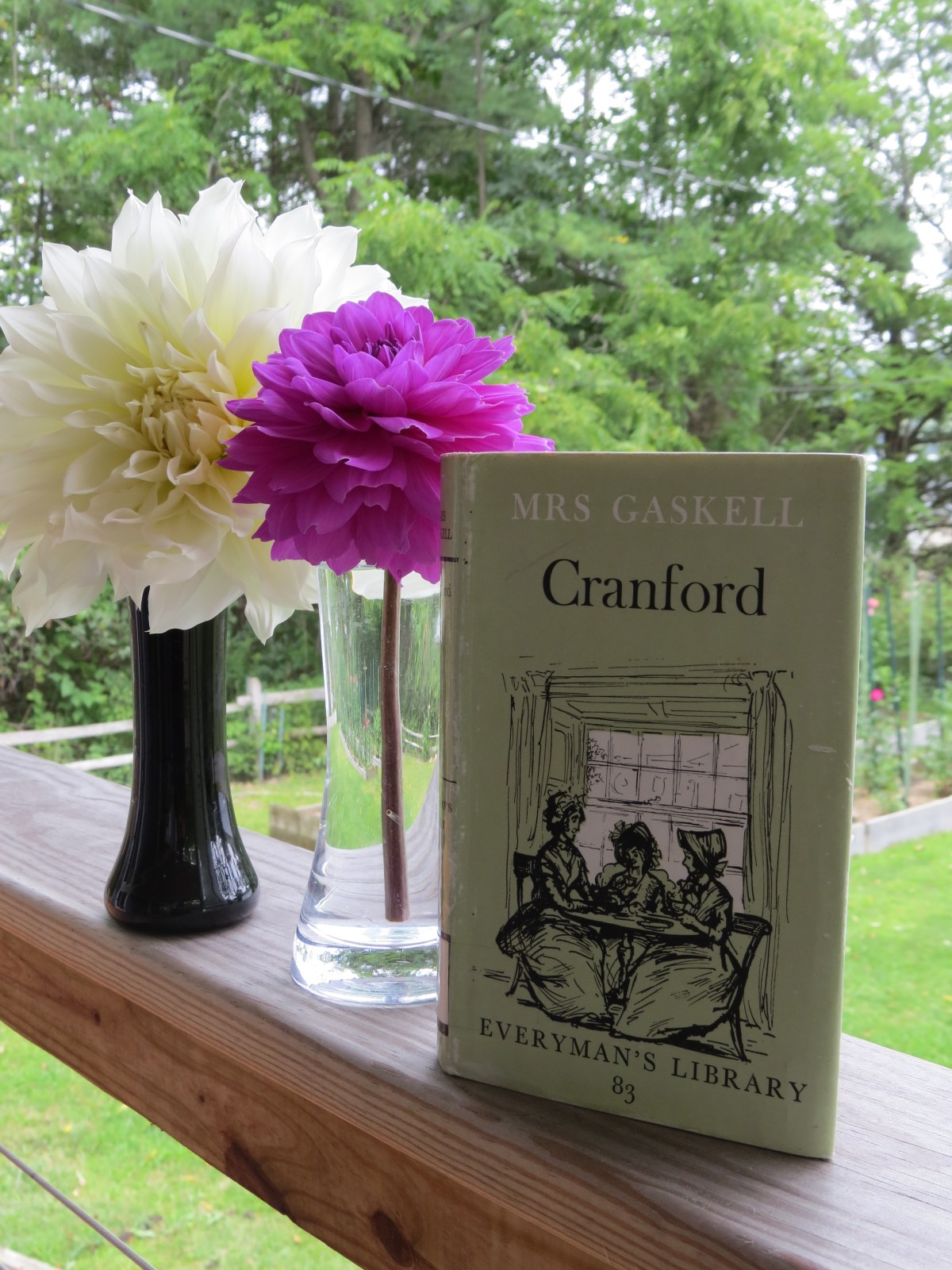
Cranford was extremely successful when published as a serial and as a book.  It was included as book number 83 in J.M. Dent’s Everyman’s Library in 1906.  It’s been adapted for television by the BBC three times (1951, 1972, 2007).  Judi Dench played Miss Matty in the 2007 version.

A few notes on the Everyman’s Library:  J. M. Dent founded the publishing firm of J.M Dent and Company in 1888 (it became J.M. Dent and Sons in 1909).  He planned, in 1904, publication of 1000 works of literature that would be affordable to all.  Per the book cover of the copy I read of Cranford:  “What Grose wrote in the Sunday Times in 1928 is even more true now that it was then:  ‘A cosmic convulsion might utterly destroy all the other printed works in the world, and still if a complete set of Everyman’s Library floated upon the waters enough would be preserved to carry on the unbroken tradition of literature.’  Raymond  Mortimer in the Sunday Times.”

By 1910 there were 500 books in the Everyman’s Library.  The title of the series was suggested by the initital head editor of the series, Ernest Rhys.  The quotation from a medival play “Everyman” was included in all Everyman Library books.  The character of Knowledge says to Everyman “Everyman, I will go with thee, and by thy guide, In thy most need to go by thy side”.  The 1000th title in the series was added in 1956 and the last title was added to the original series in the early 1970’s when it was suffering substantial competition from the new “paperback book” phenomenon.  It was relaunched in 1991 via Random House and Alfred A Knauf.  Interestingly, a goal of the new series is to provide a high quality hardbound edition of the series contents.

 The Everyman’s Library edition I read was printed in 1969 and included an Introduction by Frank Swinnerton from the 1954 edition as well as the original Forward by J.M. Dent from the 1906 Everyman’s Library edition.  It also includes the Everyman quote noted above. The photo accompanying this piece shows the cover of the edition I read and enjoyed.   Interestingly, Mrs Gaskin is no longer represented in the current Everyman Library catalog.    

Twain and The Eclipse

A Connecticut Yankee in King Arthur’s Court

By Mark Twain

Published 1889

Read September 2016

Since we’ve just (Aug 2017) experienced a dramatic eclipse of the sun by the moon, I thought it was time to write a brief post about Twain’s “A Connecticut Yankee in King Arthur’s Court”.  Please enjoy the image provided by a friend which shows the eclipse as we saw it locally with the help of leaves to cast multiple images of it on a deck surface.

When my book club decided to read this book, I was frankly not really looking forward to the experience.  I was familiar with the premise (although I realized not the whole story) and immediately recalled the eclipse segment from the Warner Brother’s “A Connecticut Rabbit in King Arthur’s Court”.  Why was this “a classic” and why were we reading it?

However, to my delight, I enjoyed listening to this book so much I listened again immediately after finishing it the first time.   The part with which I was familiar—Hank, a Connecticut Yankee in Twain’s time of the 1880’s, wakes up after a nap to find himself on the outskirts of Camelot.  He avoids being hanged as an intruder by conjuring up an eclipse of the sun (having remembered the date/time of a conveniently timed eclipse) and, after being proclaimed “The Boss” by the King, sets out to modernize Camelot with various technologies from the future.   An aspect I learned from listening— Twain totally skewers the romantic notion of Camelot and associated chivalry in a wonderfully ironic manner.  It’s well worth listening to this book as the language used by the Camelot dwellers is fabulously done and extremely entertaining when read aloud.  Hank’s wonder at the craziness of dress and customs is also quite amusing.  A favorite scene of mine recounts Hank’s incredulity that knights leave for a quest taking no food with them.  (But of course, there are no pockets in the armor that could hold even a sandwich and he even has to carry his smoking tobacco in his helmet.)  Also, a fair number of critters can get into the armor when you sleep on the ground and it’s not so easy to get them to leave….

A second aspect I learned from listening was the inability of Hank to really move the people into a more modern way of thinking and being—it would take literally centuries to get past some really awful practices (including prisoners in the dudgeon passing on to the new owner and no one remembering why they were even imprisoned).   Twain clearly had no love for the Catholic Church and shows its ability to block progress when they shut Hank down through The Interdict and associated crusade against Hank and his 54 brave soldiers.

I now fully advocate that this book is definitely “a classic”.  It remains relevant when read over a hundred years after its publication.  It is extremely humorous in a biting kind of way.   Very importantly, regardless of the age, it reminds us that technology alone is insufficient for mankind’s forward movement towards a truly just and harmonious civilization.

In this book, the eclipse enabled Hank to take a leadership role in trying to move the people of Camelot forward.   Fortunately the eclipse we experienced yesterday helped bring together the people of the US for at least a short time.  Wouldn’t it be great the eclipse can mark a new time of cooperation that can last more than a short 2 minutes?…..


Miss Jean

The Prime of Miss Jean Brodie

By Muriel Spark

Published serially in The New Yorker 1961

Published in book form 1961

Read August 2017

I am likely not alone in immediately thinking of Maggie Smith and Rod McKuen’s Oscar-nominated song “Jean” when I hear the title “The Prime of Miss Jean Brodie” despite having never read the book nor seen the 1969 movie until this summer (2017).  I have now corrected both lapses and can report that both the book and movie are worthy of individual or paired consideration.

The short novel makes extensive use of flash-forward as well as some flash-back.  Through these devices we learn the story of the “Brodie set” as they become called, starting in 1931 at age ten and having their first year of Junior School with Miss Jean Brodie, their subsequent years as they progress through the Marcia Blaine School, a conservative girls’ school in Edinburgh, Scotland, while continuing a close special relationship with Miss Brodie through their tenure, and for some of the characters, a bit about their lives after school.  The story also traces the story of Miss Jean Brodie—her unorthodox teaching approach, her fight with Miss Macky, the headmistress, to stay there vs leaving for a more “appropriate” school for Miss Brodie’s method, the renunciation of her love for Mr. Lloyd, the married art teacher (and his love for her), her love affair with Mr. Lowther, the singing master, and her eventual betrayal and dismissal from Marcia Blaine for her fascist views.

Narration, giving us only the girls’ perspectives, alternates with occasional dialog providing the reader’s only opportunity to hear Miss Brodie’s voice.  As such, we only know Miss Jean Brodie through her comments to her girls.  She is quite insistent she is “in her prime” and that she is totally committed to “her girls”.  She loves the art teacher and even shares a kiss but avoids more interactions because he is married.  She carries on a love affair with the singing master seemingly to heal her heart.   She also has some views, desires, and takes some actions that are less easy to understand—her appreciation of fascist rulers, her clear desire that Rose be her proxy as lover of Mr. Lloyd, and her strong suggestions to a new student that she run away to fight for Franco in Spain.  We can’t know what propels her to have fascist leanings or why she would find a love affair between Rose and Mr. Lloyd something for which to wish.  We do, however, learn that her effect on Sandy was far from what she intended.  Not only is Sandy the Brodie set member with whom Mr. Lloyd has an affair, Sandy also chooses to put a stop to Miss Brodie.

It was interesting to view the movie to see how the structure of the novel would be handled.  The story is told in a more “straight-line” approach.  The “Brodie set” is reduced in number by blending some of their stories together.  Sandy remains a distinct and pivotal character.  The betrayal is handled differently and Miss Brodie actually interacts with her betrayer providing a useful climax for the movie.

I think this would be a great book for a book discussion—there are so many unanswered questions about the characters and the setting of the story—1930’s Edinburgh—enabling many rich discussions.

Tess the Pure

Tess of the d’Urbervilles:  A Pure Woman Faithfully presented by Thomas Hardy

Published 1891 (serialized in The Graphic); 1892 (book form)

Read:  Sept 2016; May 2017

This book shows up as # 26 on the Big Read, a survey conducted by the BBC in 2003 to identify the nation’s 200 best loved novels of all times.  It has certainly captured a place in my heart as a best loved novel.  I’ve read it twice and anticipate I will again sometime in the future.   Why this reaction?

Caution—spoiler alert—I will reveal aspects of the plot you may not wish to learn here but which do help me describe my loving view of this book.

Tess is an absolutely marvelous character. She survives one blow after another with unrelenting courage and grace.  She is sent by her family to seek favor from rich Mrs d’Urberville, whom her lazy father learns is a distant relative. Her mother dresses her up for the journey in a way to attract the attention of Alec, Mrs. d’Urberville’s son.   Attracted he is to Tess.  She fend off his unwanted attention for several months but he seduces/rapes Tess with no offer of marriage.  She returns to her village after making clear to him she does not care for him, was blinded by him and realizes how wicked he is.  She bears his child and baptizes him herself just before he dies as an infant.  Tess chooses to leave the family to start anew at a dairy farm some distance from her home.  She meets Clare, a son of a rector and who is learning the dairy trade, and comes to love him deeply but chastely. She puts off marriage proposals from him repeatedly because of her past but eventually gives into his pleas to be his wife.   Her new husband rejects her ferociously during dinner on the night of their wedding because she tells him of the situation with Alec –just after he admits he is not a virgin himself.  Rejected by Clare, who takes off for Brazil, and again all alone, she takes a series of farm positions to support herself and eventually returns home to take care directly of her family when she learns her mother is ill and her father abruptly dies instead.  She repeatedly rejects Alec over the course of the novel as she encounters him, telling him she does not love him and loves another. She eventually decides Clare will never return to her and gives into to Alec’s offer to take care of her and her family only when her mother and siblings are literally out on the street with no means to acquire a roof over their head.  Of course Clare finally comes to his senses, too late, and finds Tess, unfortunately living as Alec’s mistress.  Tess’s one act of vengeance against Alec provides Tess and Clare a few weeks of bliss until she is captured by authorities to stand trial for her crime and we all lose Tess.

We so want Tess to find happiness so due her.  I anticipate I’m not alone in reading the novel for the second time hoping this during the second read even though I know it won’t happen.  I also anticipate I’ll read the book again with this same hope.

But is this just another romantic novel?  Why such devotion to it from myself and others?  I suggest there are a number of reasons

First, Hardy clearly loves Tess.  Hardy describes her as a Pure Woman which is a very apt description.  She stays Pure of heart throughout.  She rises above the models her parents provide her and continually seeks to live purely with limited wants for herself.  She seeks to repair damage to her family’s income by going to the cousins  d’Urberville, after an accident that happens while she is trying to literally feed the family  (while her parents lay home in bed with hang-overs) results in loss of their horse, a key component of her father’s meager haggling trade.  She doesn’t take the path suggested by her mother to trick Alec into marriage nor to keep quiet about her past to Clare.  She repeatedly reject’s Alec’s pursuit of her, even after he learns she bore his son, because she does not love him and believes him a bad person.  She remains true to Clare and never asks for anything from her parents or his parent despite her increasingly desperate position as she is eking out a living as a farm hand versus using Clare’s money he gives her when he leaves.    She in fact sends a sizable fraction of Clare’s money to her family to pay for a new roof for their rented house.  She continuously did the right thing.  Only when she has exhausted all efforts to find shelter for her mother and siblings and she has lost all hope of seeing Clare again does she acquiesce to Alec’s pursuit.  Her only act of vengeance is to clear the barrier to Clare—the fact that her “husband” Alec remains living.

Second, Hardy reveals the impact of then current standards on women.  Although Clare isn’t Pure, his wife must be.  It’s not clear whether Tess’s impure relations with Alec continued after the initial seduction or not.  Members of my book club were divided in their interpretations of Hardy’s ambiguous narration on this point.  Was Clare’s rejection of Tess purely because of a single rape resulting in a born son or was it because she remained “married” to Alec—she indicates she remained “dazed” by him for a little while (three weeks passed between the seduction of which we’re made aware and her departure from the farm)– so she could never marry another?  Regardless, it was clear that their marriage could not be consummated nor continued and they were both doomed to never marry again after taking their own vows.  Clare even toys with the idea of taking one of the other milk maids, from the dairy at which he met Tess, as a mistress for his farm in Brazil.  He rejects the notion when the girl indicates it would be impossible for her own great love of Clare to surpass the love Tess felt for him.

Third, Hardy paints us a picture of rural England at the time.  The dairy farm at which Tess and Clare meet is idyllic – beautiful pastures, milk maids finding their assigned cows in the pasture to milk them, lovely starry nights and misty mornings during which Tess and Clare find each other.  The situation is far less glamourous at the rougher farm Tess eventually stays for the contracted period when hired by the farm owner so she could afford shelter during the winter.  Tess’s hard work at this dreadful place includes feeding a dangerous threshing machine which demands to be fed through the night so that it can move on to the next farm as quickly as possible.  Hardy gives the impression both that manual farm work was difficult and provided a fairly desperate living for those bound to a farmer from season to season, and as well an impression that automation was going to disrupt the idyllic pastoral life of the English countryside.  This theme remains relevant today.  We view food production as a noble vocation and mourn the loss of the family farm while the reality of unreliable and small income from farms combined with the hard physical labor of farming, unattractive to US citizens, has led to an increasing fraction of farm labor being conducted by immigrants from Latin America.  (And the cows are no longer grazing in the fields with milk-maids coming to them or bringing them in for their milking , but rather standing in barn stalls round the clock.)

So through the tragic story of a Pure Woman who we love as much as Hardy does, Hardy provides us a picture of England at the beginning of much change brought by the industrial revolution impacting both how livings are made and how lives are led.   We see that life wasn’t simple and easy then and realize that it probably never was nor will be.  However, it’s possible to live a Pure life amidst this difficulty and remain above the fray.


Classic Dandelions

Dandelion Wine

By Ray Bradbury

Published  1957

Read May 3, 2017

Ray Bradbury published this collection of short stories, some previously published, some not, in 1957 when he was 36.   The book is set in 1928 in Green Town, IL.  Bradbury acknowledges it is based loosely on his childhood town of Waukegon, IL and on his childhood, although by 1928 his family no longer lived in IL but rather LA.

I’ve classified this book “Classic”. It year of publication (1957) is my year of birth and I’ve read this book for the first time when I’m nearly 60.  While the book is can be considered “Modern Fiction,  I classified as “Classic” because I anticipate that people will read this book in another 50 years and have it resonate as strongly for them as it did for Bradbury when he wrote it and when I read it 60 years later.

The book describes the summer of 1928 for Douglas Spalding, 12, and his family and friends.  In this summer, Douglas realizes “he is alive”.  He recognizes he’s never appreciated anything in his environment as he is now—sights, sounds, smells, events, and relationships.  Douglas recognizes that this summer will be like other summers, at least to some extent, but will be a summer unlike any other summer too.  He decides to document in a “nickel pad” summer rituals that happen every year as well as special events and new events that may happen moving forward and encourages his younger brother, Tom (10) to help him recognize each so that his record can be complete.

Over the course of the summer significant things happen in the town and we see them through the omnipotent narrator and especially through Douglas.  Technology is changing:  The trolley makes its last trip through town and will be replaced by a bus system.  The “green machine”, an electric runabout, owned by a pair of aging sisters is put away after forever after a near accident.  Relationships are changing:  Doug’s best friend, John, announces that he will be moving away and will be leaving that night.  Great Granma dies, but not before she speaks with Doug and then his family while literally on her deathbed.  The community loses members:   Colonel Freeleigh, a civil war veteran and source of colorful oral history that Doug and his friends enjoy hearing, dies after spending his last days under strict nursing care.  All of these events are timeless.  Although we hear about them as they occur in 1928 in Greentown, IL, they are the kinds of events that we all experience at some time.  Bradbury captures this timelessness with beautiful and descriptive language that is a treat.

Bradbury uses these events to point out Doug’s “coming alive” and how differently he is experiencing them  now that he “is alive”.  He drills this home when Douglas is very sick near the end of summer.  His brother, Tom, describes to the local junk man that Doug has had an especially hard summer and that’s maybe why he’s suffering so now.  The various trials that Tom recounts include such things as losing a precious aggie marble, having his catcher’s mitt stolen, and making a bad trade of his fossil stones and shell collection for a clay statue toy.  But they don’t include the significant events noted above that Doug has experienced so differently than he has in the past that he is truly overwhelmed by it all, especially the recognition that he too will die someday.

This can be viewed as a book about a boy’s summer (and one critic at the time indicated that no summer is like this for any real boy).  But this book speaks to us about our own evolving experiences with the realities and mysteries of life, with growing up, and with growing old.  The chapter/story about Mrs. Bentley and her interactions with the neighborhood children is especially revealing in this regard.  The children refuse to believe she was ever a girl but rather that she’s always been old.  She tries to convince them that she too was once young including showing them things she’s save from her youth including a photograph.  They remain unconvinced and she eventually agrees that 50 years ago she was the same age as she is now.  This declaration allows her to release the precious saved memorabilia and validate her dead husband’s view of focusing on the present vs the past.

The book includes a number of remarkable stories.   The chapter/story about old Miss Helen Loomis and young Mr Bill Forrester and the relationship they can’t have now but might have had if only the timing of their lives was different now (or later??)  is another example of Bradbury’s ability use a short story to tell so much more than storyline.  His “horror” story about Lavinia Nebb and her friends walk home from the movies the night of a recent serial killing draws us to the edge of our seats.  The next chapter of the book tells us about the outcome and the boy’s reaction to it.  After reading the chapter/story about Cream-Sponge Para Litefoot Shoes, I will never put on a pair of sneakers again without wondering if they have the magic that Douglas’s pair had.

One of Bradbury’s early commercial successes of significance came when a publisher suggested Bradbury collect together some of his stories—they became The Martian Chronicles.  When Bradbury put together a collection of stories about Green Town, IL, his publisher convinced him that it was too long so Dandelion Wine was published first (1957) and a follow-up, Farewell Summer, was eventually published in 2006.

Both Bradbury and his readers are lucky that he decided to be a writer at a young age and was able write daily essentially up to his death at age 91.  His work has been published in many forms and formats (stories in magazines, collections in books, plays on the radio, TV, and as movies.)  He received many awards over his life, including the National Medal of Arts in 2004, nominated by the National Endowment for the Arts and presented by then president George W Bush.   Although he was credited by the New York Times for being “the writer most responsible for bringing modern science fiction into the literary mainstream” (1),  this book demonstrates his range and poetic capabilities.