A Thousand Ships–a view of post-Trojan Wars

A Thousand Ships

By Natalie Haynes

Published 2019

Read April 2022; May 2024

Natalie Haynes has been a stand-up comic, a print, radio, and TV journalist, and has published several non-fiction and fiction books.  She studied The Classics at Cambridge and has spent much of her career enabling the public to engage with and enjoy the classics. 

In this book she tells tales about the Trojan Wars—through the perspectives of the women involved.  This reader was quite enchanted by this book.  When unfamiliar with a particular god, goddess, or story, this reader consulted Wikipedia to get a little background which enabled great appreciation for Haynes’ witty and often cutting take on the story. 

Thank you, Natalie Haynes, for breathing life into these stories and inducing me to learn more about them.

Tom Lake—another Patchett great

Tom Lake

By Ann Patchett

Published 2023

Read July 2024

This reader has read many, but not all, of Ann Patchett’s books including her essay collection, These Precious Days. Once again, this reader is impressed with Patchett’s ability to weave a story unlike any of her previous stories.

This story is set in the spring of 2020 during the early part of the COVID-19 pandemic when avoiding others was the primary source of prevention.  Lara’s three daughters in their twenties are back on the family fruit farm near Traverse City Michigan as a result of this state of the world:  Emily, the oldest and who lives on the property, works with her father, and fully intends to continue the family farm for another generation; Maisie, a vet student who is helping neighbors with their animal problems in a social distancing way; Nell, a theater student who desperately wants to be an actress and fears this pandemic is taking away precious years from her career.   The usual crews who helped the Nelsons pick their sweet cherries are mostly not working this year because of the pandemic so it’s up to Lara and the three daughters to pick the sweet cherries which require hand picking. While they pick, they pry from their mother her story of a summer at Tom Lake, a nearby summer stock theater, where she played Emily in Our Town and had a steamy summer romance with Peter Duke who is now a famous TV and movie actor.

Patchett moves between Lara’s narration of her story and the present day to day goings on at the farm.  Patchett opens the book when Lara (then Laura) was in high school and was roped by her grandmother into registering people for auditions for her New Hampshire town’s production of Our Town.  Lara decides to audition and wins the part of Emily.  She’s uncertain about what to do with her life so attends a state university and ends up getting the part of Emily again for her college’s production of the play.  She acknowledges she has a very lucky break when the uncle of another cast member attends a performance and decides she’s perfect for a part in a movie he’s producing in Hollywood. After the movie is completed and she’s done a few commercials, it’s suggested she takes advantage of another lucky break—the actress playing Emily in a summer stock theater (Tom Lake) has abruptly left and a replacement is desperately needed. 

The structure of the book is pleasant.  The reader gets some feel for the large amount of human labor involved in raising cherries near the Lake Michigan shoreline of Michigan, gets a look at Lara’s family, and gets a glimpse of summer stock life and Lara’s steamy romance.   Some critics have complained there isn’t much that happens in this book.  Well, this book is about life and most lives don’t have lots of extraordinary events in them, but most lives do require decisions to be made now and then that influence the course of that usually ordinary life.  That’s mostly what we get in this book although Lara acknowledges the lucky breaks she had and one unlucky break she had that helped her decide a course that she clearly doesn’t regret. 

Lots of themes in this book despite the lack of any major calamity:  family, friendship, love, loyalty, honor, ambition, regret, personal bravery, loneliness/connectedness.  We see a couple of actors/actresses trying to make it in their dreadfully challenging career path and we wonder if Nell will be able to make it. The COVID pandemic provided a device for the structure of the book and fortunately doesn’t otherwise get in the way.  It’s possible its use will “date” this book more than others she’s written.  But it’s really the multiple interesting characters we get to know in depth or at least a bit that make this book the joy that it is to read.  As usual this reader looks forward to more from Ann Patchett. 

A Land Remembered—Family saga and Florida history

A Land Remembered

By Patrick Smith

Published 1984

Read Feb 2023

A friend of this reader lent her a hard copy of this book.  When it became known that an audiobook was available, read by George Guidall, a favorite reader of this reader, the hard copy went back and the audiobook went on. 

This reader now lives in southwest Florida where new residents are flocking at a high rate.  Thus, this saga of three generations of MacIveys from 1858 to 1968 was particularly interesting.  During this period Florida began transforming from a wild frontier to a developer’s dream as people began vacationing in and moving to Florida’s east coast in droves.

Tobias MacIvey and his wife and infant son migrate from Georgia to the east side of Florida.  There they scratch out a meager existence.  Eventually Tobias learns to capture wild cattle, fatten them for market, and make a treacherous trip to Punta Rassa on the west coast where they sell the cattle which are then shipped to Cuba.  There is a full cast of interesting characters with whom the family interacts over time.  Much of the story focuses on Tobias’s family and their challenges living in the wilderness of Florida. 

Over time the wide open spaces across which they drive their cattle become purchased by various people and fences start going up.  Tobias buys some of this land as well.  Thus begins the family’s foray into property ownership and the transformation of Florida from a wilderness to a “settled” state in which developers buy and sell property and literally transform the geography of the state.

This book will appeal to those interested in the history of Florida, to those who are interested in family sagas, and to those who just plain enjoy good writing and a good story.  As this reader fits all of these categories,  this was a pleasurable and educational experience. 

The book was published by Pineapple Press, a niche publishing company that specializes in books about Florida in some way—non-fiction and fiction alike. 

Clare Keegan’s Brilliance

By Claire Keegan

Walk the Blue Fields Published 2007 Read Aug 2023

Foster  Published 2010 Read June 2023

Small Things Like These Published 2021 Read June 2023

This reader discovered Claire Keegan by a well-trod route for this reader:  her book club. 

The author is an amazingly gifted who can tell a profound story in a few pages.  Each novella or story has left this reader sitting back to say “Wow” as the author provides so much punch in so few words.   So much told in a few pages and simultaneously so much left unsaid but known. 

Foster and Small Things Like These were the first works read by this reader and the focus of the book group.  Both were published as novellas. Walk the Blue Fields is a book of short stories this reader chose to share with a “book buddy” while driving about a thousand miles on a trip. 

Foster paints the story of a girl sent to live with a distant relative for a few months while her mother is giving birth to yet another baby.  We engage quickly with the girl and worry with her as she adjusts to living with her aunt and uncle.  We are thrilled as the three settle into a warm pseudo family unit for a brief few weeks and we are shattered with them when the girl’s father returns to retrieve her.

In Small Things Like These we walk with the protagonist and listen to his thoughts as he interacts with his family, employees, and customers on two days—Christmas Eve and Christmas Day.  We learn with him a secret from his past which, coupled with his already firm appreciation of his mother’s employer’s treatment of him, drives him to make a life-changing decision.  Two days and 128 pages packs a powerful punch for the protagonist and the reader. 

Walk the Blue Fields gives the reader seven stories that are often melancholic, sometimes about people who have lived through or are living through extremely difficult situations, and which are always rich and memorable.  My book buddy was about to cry “uncle” — enough sad stories when we listened to the last one.  Sad yes, absurd yes, and hysterical at the same time.  We both agreed we’d likely read more of this author. 

Claire Keegan is an Irish author whose work has won a number of awards.  She was inducted into Aosdana in 2008 (an Irish association or academy of artists, each of whom must have produced a distinguished body of work of genuine originality; membership is limited to 250)(1). 

The 3 Body Problem

The 3 Body Problem

By Cixin Liu

Translated by Ken Liu

Published 2008 (Chinese)

Published 2014 (English Translation)

Read Feb 2024

Netflix series season one launched and viewed March 2024

This reader’s son recommended this book.  He had completed Liu’s trilogy, Remembrance of Earth’s Past, and thought this reader would find this book interesting.  He was right.  As a trip to see our son was imminent, this reader and her husband viewed the very recently released Netflix series based on Liu’s trilogy.  This essay will discuss both the book and the first season of the Netflix series. 

The setting of the book and series moves between the present and the era of the Cultural Revolution in China.  

The book’s first chapter and the opening scene of the Netflix series introduces us to a primary character, Ye Wenjie, as she watches her father, Ye Zhetai, a professor of physics, beaten to death by high school girls as part of a public demonstration as the Cultural Revolution worked to wipe out “Monsters and Demons”.  Ye Wenjie’s mother, Shao Lin, another physicist, publicly denounces her husband as counterrevolutionary at that demonstration because he is teaching about the theory of relativity in his classes.  This reader was surprised this scene would be at the beginning of a book originally published in China and it turns out that it wasn’t.  The translator, Ken Liu, suggested to the author that this chapter be moved from the middle of the novel to the beginning.  The author readily agreed as he originally intended this chapter to be at the beginning of the novel, but the chapter was moved to the interior of the novel to avoid issues with the government.

The reader or viewer next encounters Ye Wenjie as a member of a work crew that is clear cutting a forest near a government facility with an unusual antenna.  After she is discovered with the book Silent Spring by Rachel Carson in her possession, she is arrested and given the opportunity to go to work at that government station with the likelihood of never leaving it, or to suffer other unnamed consequences.  She goes to work at the facility, known as Red Coast Base.  She eventually learns that the base is seeking to interact with other worlds through its sophisticated antenna.   Ye Wenjie’s contributions as an astrophysicist aid the work and take it in a direction that is not fully known by her superiors.

In present times, a police detective is engaged to discover what is leading famous scientists around the world to commit suicide.  The book’s setting is present day China, and a nanomaterials scientist is the main character involved with the detective to understand the situation.  The Netflix series sets the modern-day story in and around London and uses five friends who were students together in physics at Oxford to drive the story.  At first this reader was somewhat dismayed by this but later decided it was a good move—this approach will engage a broader audience than the much more “hard-core science fiction” novel. 

In both the novel and the series, an ultra-realistic “videogame” is “played” by various scientists.  In the novel, the author spends much time on the details of what the nanomaterials scientist encounters in the story each time he plays the videogame and what he is learning.  In the Netflix series, there is less time spent on the content of the game aside from comments on the vividness of the setting and adds a young girl to the videogame story that again is designed to engage a broad audience. 

This reader greatly enjoyed the “hard core science fiction” aspect of the novel.  Details of the technologies being described and the math behind the 3-body problem were quite engaging.  The details of the forty million strong human “computer” were especially fascinating.  The Netflix series adaptation touches on some of these interesting technologies but not deeply and focuses more on the human relationships very appropriate for engaging an audience well outside of, but including, the “hard core science fiction” audience. 

Both the novel and the series force us to question a prevailing attitude — that if there is life out there somewhere beyond Earth, we should engage with them because we will learn from them and be better for it.  We’ve certainly been shaped to believe this by the frankly short Star Trek series of the sixties and the various series it spawned as well as by some science fiction.  This novel blatantly challenges us to consider the opposite. 

This first book of a trilogy ends on a somber note.  The Netflix series extends beyond the first book into later parts of the series which again will engage the audience to watch to the end of the first season and look forward to more of it.  This reader applauds this approach as the questions posed are important ones. 

A bit on the history of the novel: 

The author was born in Beijing, China in 1963.  He is described as a computer scientist and author.  This book is the first part of a trilogy, Remembrance of Earth’s Past.   This novel is the recipient of the Hugo Award for best novel (2015), the first time a Chinese author has won this award and the first time a translation has won the award. A China based publishing company approached Ken Lui and Joel Martinsen to translate the three books in the series.  Ken Lui translated books 1 and 3 while Martinsen translated book 2.  Ken Lui was born in China but came to the US with his parents in 1987 at age 11.  He received a BA in English Literature and Computer Science from Harvard, worked as a computer scientist for Microsoft, obtained a JD from Harvard Law School (2004) and worked as a high-tech litigation consultant.  He began publishing science fiction in 2002.  His work has been highly decorated with various awards and has been translated into Chinese.  He has translated the work of several Chinese science fiction writers from Chinese into English which has enabled a broader audience of Chinese science fiction.  Joel Martinsen is a free-lance translator who has much experience translating Chinese works into English. 

Golden Hill: A Novel of Old New York

Golden Hill:  A Novel of Old New York

By Francis Spufford

Published 2016

Read Feb 2024

Like many books with which this reader engages as a result of her book clubs, this is one this reader never would have known about, considered, read, or had the delight to read.  That’s a reason for book clubs!  To read things that we wouldn’t otherwise and to discuss with a group of people interested in delving into the whats, whys and wherefores of a book and its author.  

Francis Spufford’s first foray into fiction is an interesting one. BBC Radio’s blurb includes this statement:  “The best eighteenth-century novel since the eighteenth century.”  Fortunately we’re spared the spelling approach used in 1746 except for a letter by the protagonist to his father.  But what we are treated with is a rollicking novel with adventure, mystery, romance, a duel, and a little sex.  There is a wonderful twist at the end regarding the source of the story but certainly don’t read it early.    

Richard Smith arrives in New York City in November 1746, a full three decades before the Revolution.  New York City is an unimaginably small town at that time, population about 7000, with chickens and cows grazing in the countryside which is remarkably close to the downtown section.  Richard Smith is a young man who immediately upon his arrival presents to the counting house a bill for a thousand pounds from one Barnaby Banyard of London.  Smith requests cash for the bill which the counting house cannot provide—-it seems that much cash is not to be found anywhere in New York City.  Smith is willing to wait 60 days for the money so that another ship’s letter can confirm the bill’s validity.  Smith’s adventures start the very next morning when his purse, containing the cash he did obtain from the county house and the bill, is stolen and he now must figure out ways to feed and house himself for the next sixty days. 

The story takes place between November 1, 1746, and Dec 25, 1746 and it’s packed with the many adventures of Smith and his various encounters with the people of the town—the counting house owners and his daughters, lawyers, the Governor and his Secretary, persons celebrating Pope’s day in the streets, and many more.  Since New York is so small, everyone in town is aware of his presence and his activities and all are interested in his business and source of funds, but no one learns them until the very end of the book.

This is the type of historical fiction this reader enjoys:  1) fictional characters and their story with the backdrop of a real place and time that are drawn with wonderful accuracy. 2) A story that interacts with real people of the time doing realistic but fictional things. 3) A story that doesn’t imagine the feelings of real figures of the time.  In this historical fiction novel, we learn much about the city itself, the type of people that populate it, and its culture.  We learn about the competing churches and their members, “Pope Day”, the celebration of His Majesty’s Birthday, Sinterklaasavond (St Nicholas’ Eve), how Christmas Day was and wasn’t celebrated by various (all Christian) churches, and more.  We learn that the slave trade is a well-established and significant component of the economy of the time—nearly thirty years after 1619, and that most of the upper class have one or more house slaves, and how they treat them.  While the author keeps us nicely focused on the many events happening to Richard Smith through a mere sixty days, we can’t help getting a sense of the racism and sexism that was well engrained in the culture and a chance to wonder at how much or little progress we’ve made in the intervening 270 years between the story’s setting in 1746 and the book’s publication in 2016.

While this reader had to work a bit at getting started with this book, once fully engaged she was quite gripped by the story, the characters, and the picture of Old New York the book provides.  The final chapter—don’t read it until the end!—was a marvelous ending for the book.  It both provides some small sense of “what happened next” and a somewhere jarring but welcome call to the rest of what the author might have hoped we would learn about the real history of our country. 

There is a interesting YouTube video at :  https://www.youtube.com/watch?v=NhPXz5eHmIM called Golden Hill:  Francis Spufford shows us 18th Century New York that’s well worth its 2min 8 second run. 

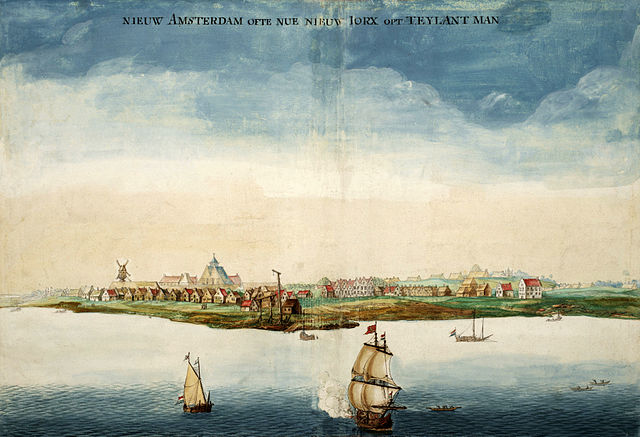
The painting in the image shows the town in 1653.  The painter and its source:  By Johannes Vingboons – Geheugen van Nederland (Memory of The Netherlands), Selections from the Map Collections http://international.loc.gov/cgi-bin/query/r?intldl/awkbbib:@field(DOCID+@lit(awkb012367)), Public Domain, https://commons.wikimedia.org/w/index.php?curid=238390

Amy and Isabelle–Strout’s first novel–don’t miss it


Amy and Isabelle

By Elizabeth Strout

Published 1998

Read Feb 2024

This reader has now read all of Elizabeth Strout’s published
books, the order being Olive Kitteridge  first following by Abide with Me
(before this website was started) then the Lucy Barton books, My
Name is Lucy Barton
and Anything is Possible.  Next this reader
read Burgess Brothers while waiting for more new Strout books which were read when availableOlive Again! ,  Oh William, and Lucy by the Sea (post coming soon).  That left Amy and Isabelle on which this reader now reports.


Amy and Isabelle was Strout’s first novel, published in 1998.  The story is set in Shirley Falls, Maine, to where Isabelle moved with her young daughter,  with a wedding ring on her finger and a sad story that she had lost her husband and her parents were also dead.   Isabelle has remained a single mother, an
unusual situation in this town in the 1960’s. She doesn’t seem to have any friends and she and Amy live at the edge of the town in a rented house.  She is
secretary to Avery Clark at the town’s mill and remains separate from the other
women in the office. 

When the reader enters the story, 16-year-old Amy is working in a summer job her mother arranged for her.  Amy is temporarily replacing one of the women in the office who has recently has a hysterectomy and is recuperating at home.  It seems that woman was who usually listens to the stories of another office worker (Fat Bev) and now Amy is replacing that role as well.  Amy seems to like hearing the chatter of the office women but she clearly is not happy spending so much time in the same room as her mother.  Something has happened that causes Amy not to look in mirrors and the women to wonder why she has cut her hair so short.  We learn shortly that Isabelle’s daily prayers include asking for a better daughter.  So by the end of the first chapter, we expect to learn more about an untoward relationship between Amy and Mr. Robertson, a teacher at her school who the opening lines indicated left town that summer. 

Amy is quiet and shy, in high school, and seems alone save her friend, Stacy, with whom she shares cigarettes under the bleachers.  Stacy has broken up with her older boyfriend who likes going to bed with her.  It seems Stacy is bored with this preoccupation and we also learn at the end of chapter 1 that Stacy is pregnant. 

The story alternates between the present as Amy listens to Fat Bev, her mother pines for Avery Clark, and the search for a missing girl in the area continues, and a progression of events of the past school year as Amy’s relationship with school and her best friend Stacy evolve.  Amy has detention with her math teacher, Mr. Roberston, and then seeks reasons to continue to speak with him alone after school.

During these hot spring and summer months, the usual strain parents of high schoolers experience is underway.  Amy’s descriptions to her of her afterschool activities are quite different from actuality.  Both mother and daughter are quite disturbed by the apparent abduction of the local girl who hasn’t yet been found.  Amy pokes fun at Isabelle’s pronunciation of Yeats which leads Isabelle to try to educate herself with literature.  She first tries “Hamlet” which she can’t understand and then she reads “Madame Bovary” which she can understand but leaves her somewhat confused and agitated.   But the strain has skyrocketed even before it really began when Avery Clark discovers Amy and Mr. Roberston pursuing intimate acts in Mr. Roberston’s car.  This precipitates a fault line in Isabelle’s relationship with her daughter, with Mr. Avery, with the other women in the office, and with her past.

This book differs from many of Strout’s later novels that tend to describe scenes in the lives of other members of the community.  In this book, the focus is firmly on Amy and Isabelle.  Both become more isolated from others and now very isolated from each other after the incident.  Strout handles all of this in a seemingly calm fashion that at the same time enables the reader to feel everyone’s pain, frustration, and loneliness.

While this novel can well be described as nuanced, it also has many more descriptions than her later novels of the events and thoughts of the characters, and especially regarding the physical landscape of the area.  This gives this novel a richer, or perhaps, somewhat bulkier feel than her later novels.  In addition, this novel is not narrated by a character but rather we have an omniscient narrator that reveals both Amy and Isabelle’s feelings to us. 

This reader is glad to have finally read this first novel by Strout and to have met these characters.  Isabelle appears again in Olive Again!. This reader may revisit that book with new understanding of Isabelle.  Such an interesting web of books Strout has provided us and a new one coming in the summer of 2024!  This reader looks forward to more from this author.


Anne Hillerman–Joe Leaphorn, Jim Chee, and Bernadette Manuelito Series

The Anne Hillerman Joe Leaphorn, Jim Chee, and Bernadette Manuelito Series

Spider Woman’s Daughter            Published 2013 Read Sept 2023

Rock with Wings                              Published 2015 Read Sept 2023

Song of the Lion                              Published 2017 Read Sept 2023

Cave of Bones                                  Published 2018 Read Oct 2023

The Tale Teller                                  Published 2019  Read Oct 2023

Stargazer                                           Published 2021 Read Oct 2023

The Sacred Bridge                           Published 2022 Read Oct 2023

As discussed in Books-How They Mattered to Me This Year  this author read extensively during some really difficult times.  After completing the Tony Hillerman Canon of novels about the Navajo Nation starring Joe Leaphorn, Jim Chee, this reader turned to the Anne Hillerman novels.  Daughter of Tony Hillerman, she continued the series.

This reader appreciates the approach Anne Hillerman took with this series.  In the first installation of her series, Joe Leaphorn plays a small role as he is shot in an early scene and spends most of the rest of the book in a coma and later beginning to recuperate.  This provides Anne Hillerman a chance to expand attention on Bernadette Manuelito who witnessed the shooting and is very conflicted about it as she feels she should have done more to prevent it (which wasn’t possible).  Thus begins the series which give more focus on Bernadette Manuelito, a character introduced in the later Tony Hillerman series where she slowly evolved from an officer in Jim Chee’s station, to someone who is attractive to Jim Chee (and vice versa), to Chee’s girlfriend, and eventually to Chee’s wife. 

During the first Anne Hillerman book, this reader wondered if Joe Leaphorn was going to be permanently written out of the series but was pleased that he does remain a character who is now consultant to the Navajo Nation police while retired.   Bernadette Manuelito’s challenges with her mother who needs some in-home care and her sister who provides it and her ambitions to be a detective and the potential conflict that job will have with family life involving children become part of the over-arching flow of the characters’ stories.   

Since the readers of this series were not George Guidall and varied across books, this reader reverted to reading with her eyes instead.  The new readers tended to read flatly—no differentiation in “voicing” for the different characters which this reader missed greatly after George Guidall’s approach.  But clearly this reader enjoyed the series as she read all that were available in the fall of 2023.

While preparing this post, this reader learned that another book in the series was published in 2023 so there is another book to read—hooray!

The photo shows Shiprock, the geological monument in the Navajo Nation for which the nearby town Shiprock is named.

Tony Hillerman–Joe Leaphorn/Jim Chee series

The Rest of the Tony Hillerman Joe Leaphorn/Jim Chee Series

Dance Hall of the Dead:                Published 1973 Read Nov 2021

The Dark Wind:                               Published 1982 Read May 2022

People of Darkness:                       Published 1980 Read May 2022, Oct 2022

Listening Woman                             Published 1978 Read Oct 2022

Talking God                                       Published 1989 Read Oct 2022

The First Eagle                                  Published 1998 Read Dec 2022

The Fallen Man                                Published 1996 Read Dec 2022

Sacred Clows                                    Published 1993 Read Dec 2022

The Wailing Wind                            Published 2002 Read Jan 2023; sometime before 2016

The Sinister Pig                                Published 2003 Read Jan 2023

Hunting Badger                                Published 1999 Read Jan 2023

Skinwalkers                                       Published 1987 Read Feb 2023

Skeleton Man                                   Published 1986 Read Feb 2023

Shape Shifter                                    Published 2006 Read Feb 2023

As discussed in Books-How They Mattered to Me This Year  this author read extensively during some really difficult times.  The Tony Hillerman books were a great comfort as they gave me a great mystery, a set of characters whose stories evolve a bit in each book and over the course of the series, and especially as they gave me insight into the Navajo Nation and the Navajo culture and the land on which much of it resides.  The list noted above was read mainly through audiobooks with the same reader—George Guidall.  His interpretation of the text and the life he gives the characters through his voice are great. 

This reader has touched on Tony Hillerman books in previous blogs as this reader has frequented the author’s book occasionally for quite some time.  You will note that this reader read these particular books in rapid succession, although not in chronological order of their publication.  Having the same reader for the audiobook throughout the series enabled consistency which this reader greatly appreciated. 

A lovey aspect of this series is that it’s not necessary to read them in order of publication, although the slowly evolving overarching story of the characters does progress with the order of publication.  The reader can settle into the story rapidly whether it’s the first story with these characters or the tenth.  A primary focus is the particular mystery, the secondary focus is on the land, people, and culture of the Navajo Nation, and the third is on the particular state of the story of the characters. 

Tony Hillerman has authored other fiction books and a number of non-fiction books which this reader has not read—yet.   

Unfortunately, the world lost Tony Hillerman in 2008.  His daughter, Anne Hillerman, extended the Joe Leaphorn, Jim Chee, and Bernadette Manuelito series which this reader has also read and will comment on separately.

The photo shows Shiprock, an important geological monument in the Navajo Nation and for which Shiprock, the town in which the stories are set, is named

Bruno Chief of Police series by Martin Walker

Martin Walker—Bruno Chief of Police Books

The Dark  Vineyard                         Published 2009  Read Jun 2022

The Resistance Man                       Published 2013 Read July 2022

The Crowded Grave                        Published 2011 Read July 2022, Sept 2022

Black Diamond                                 Published 2010 Read July 2022

The Templar’s Last Secret             Published 2017  Read Aug 2022

The Patriarch                                    Published 2016 Read Aug 2022

The Children Return                        Published 2014 Read Aug 2022

Fatal Pursuit                                      Published 2016 Read Aug 2022

The Coldest Cave                            Published 2021 Read Sept 2022

Shooting at Chateau Rock             Published 2020 Read Sept 2022

Caves of Perigold                             Published 2022  Read Sept 2022

Body in the Caste Well                   Published 2019  Read Sept 2022

A Taste for Vengeance                    Published 2019  Read Sept 2022

This reader began reading this series previously but in June of 2022 binge reading of this series started.  This reader was progressing through the series when the matter discussed in Books-How They Mattered to Me This Year  occurred.  This series was one of several that enabled me to deal productively with the events. 

This series of books is about Benoît “Bruno” Courrèges, a former soldier and current police chief (and only police officer) of a small village in the Perigold region of France. The book series follows Bruno as he deals with mysteries that regularly involve international matters and thus the national police force for which his former (and sometimes current) ambitious lover works.  Bruno owns a small house with a garden and chicken coop which provide him items he supplements with purchases from the village to make scrumptious meals he often shares with his friends.  (A friend of this reader has termed the series a sort of food porn due to the details of the ingredients and food preparation).  The reader is also always treated to some sort of history lesson of France or the local region.  As with other series, there is a slow arc across the books regarding the story of Bruno, his loves, and his friends. This series delighted this reader by using the same reader for all the audiobooks to which she listened—Robert Ian MacKenzie. This reader was delighted to learn that more Bruno books have been published. Hooray!